
Structured Data Is Dead. Long Live Structured Data
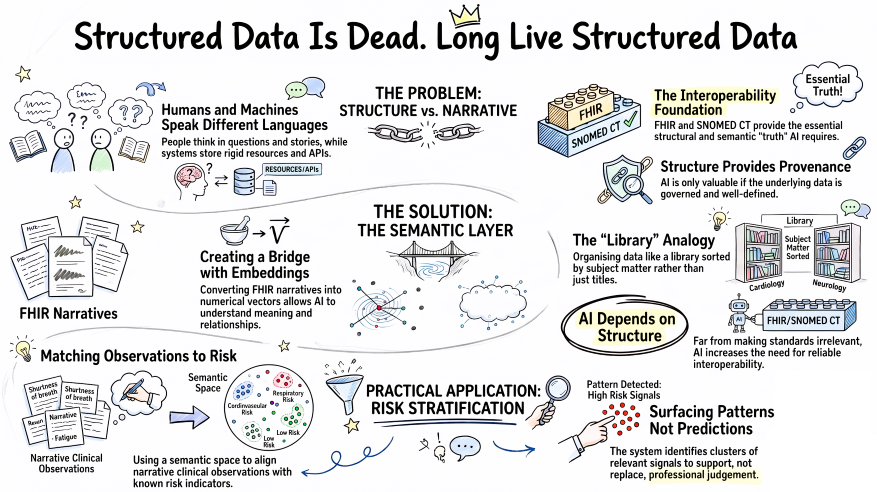
There is no shortage of discussion about the opportunities that AI may create within health and social care. One of the most compelling aspects of modern language models is their apparent ability to work with information in ways that feel much more natural to people. They can interpret narrative, summarise documents, answer questions and identify relationships across large volumes of information, capabilities that have traditionally been difficult to achieve with structured systems alone.
This is particularly interesting in health and care, where information is often a mixture of structured data and narrative content. Care professionals record observations, concerns and contextual information as stories as much as they do as coded data. Likewise, when people consume information, they tend to think in questions, narratives and concepts rather than resources, fields and data models.
At first glance, this can lead to an obvious conclusion: if AI can work effectively with both structured and unstructured information, perhaps structure no longer matters.
In other words, perhaps structured data is dead.
During a recent proof-of-concept project, we found ourselves exploring exactly that assumption. If modern AI systems are so effective at working with narrative, how much does the underlying representation of the data really matter?
The answer turned out to be rather unexpected.
Far from making structured data less important, AI made us appreciate its value even more. Whilst language models were remarkably effective at working with narrative content, the real challenge was ensuring that information could be represented in a way that preserved meaning, context and provenance.
That realisation led us to what became one of the most important architectural concepts within the project: a semantic layer built over FHIR.
By combining structured interoperability standards with semantic technologies, we began to see a way of bridging the gap between how systems store information and how people understand it.
TL;DR
🏛️ FHIR and SNOMED CT provide the interoperability foundation.
📖 People think in narratives and concepts, not data structures or code systems.
🧠 FHIR narratives can be transformed into a semantic layer using embeddings.
🎯 Semantic layers enable capabilities such as natural language search.
✨ AI depends on structured data more than ever.
Structured data is the foundation
The proof-of-concept project began with a data model used to capture and exchange care information. For interoperability purposes, that model was transformed into HL7 FHIR resources, providing a consistent and governed representation of information.
FHIR gave us:
- A standard information model
- Consistent resource definitions
- Validation and governance
- Standard APIs
- A shared understanding of how information should be represented
Alongside this, concepts within the source model were codified using standard terminologies such as SNOMED CT. This is an important distinction. Whilst FHIR provides the structure through which information is represented and exchanged, terminologies provide a shared understanding of what that information actually means.
Together, these standards enable both structural and semantic interoperability. FHIR ensures that systems represent information consistently, whilst terminologies ensure that coded concepts are interpreted consistently when information is exchanged between those systems.
It is worth noting, however, that semantic interoperability and semantic search are not the same thing. Standards such as SNOMED CT provide a shared understanding of coded concepts, ensuring that systems attach the same meaning to the same information. The semantic layer serves a different purpose. Rather than focusing solely on coded concepts, it enables AI systems to identify relationships between narratives, observations and questions expressed in natural language.
In effect, we had a robust interoperability foundation. Data could be exchanged, validated and understood reliably across organisational and technical boundaries. FHIR became the structured representation of truth within the proof-of-concept, whilst terminology standards helped establish a common understanding of meaning.
That foundation was essential. Without it, creating a reliable semantic layer would have been significantly more difficult.
However, despite providing both structural and semantic interoperability, it still left an important challenge unresolved:
How do you make highly structured information useful to AI systems and, perhaps more importantly, more useful to people asking questions about that information?
Structured data and human questions are different things
People do not think in FHIR resources, APIs, search parameters or resource relationships. They think in questions, narratives and stories. A care professional is perhaps far more likely to ask:
- “Has this person’s behaviour changed recently?”
- “Are there any concerns emerging in the data?”
- “What patterns have appeared over the past few weeks?”
Equally, when professionals record information, they frequently do so through narrative. Letters, reports, observations, risks, concerns and contextual information are often expressed using free text alongside structured data. Rather than describing relationships through resource structures, they describe what they have seen, what has changed and why they believe it might be important.
This is how humans communicate meaning. We tell stories, connect events together and place things into context.
These are not questions about structure. They are questions about meaning.
A structured model tells us what information exists and where it exists. It is extremely effective at representing information consistently and unambiguously. What it does not necessarily do is help us understand how different concepts relate to one another, particularly when those concepts are described differently or expressed within narrative content.
That is where the semantic layer becomes important. It provides a mechanism for relating concepts, observations and narratives based on meaning rather than simply structure, creating a bridge between how people think and how information systems store data.
Creating a semantic layer over FHIR
One of the key observations from the project was that FHIR and AI address different problems. FHIR is designed to represent information consistently. AI is designed to work with meaning.
Rather than attempting to bypass FHIR, we decided to build directly on top of it.
From data standards to FHIR
FHIR resources already contain a narrative representation through the text.div element. These narratives provide a human-readable view of the underlying structured data, remaining fully aligned to the source resource whilst making the information more accessible to both people and AI systems. As such, they formed a natural bridge between machine-readable interoperability standards and natural language processing techniques. Rather than generating embeddings directly from raw operational data, we used the FHIR narrative representation itself as the foundation for the semantic layer.
The architecture was broadly:
flowchart LR
    subgraph SD[Structured Data]
        direction TB
        A(Operational Data Standard) --> B(FHIR R4)
        B --> C(Narrative Representation)
    end

    subgraph SEM[Semantic Layer]
        direction TB
        D(Embeddings) --> E(Vector Store)
        E --> F(Semantic Representation)
    end

    C --> D

    classDef base fill:#437c9f,stroke:#2f5f79,color:#ffffff,stroke-width:1px;
    classDef highlight fill:#6dc067,stroke:#437c9f,color:#1f2d1f,stroke-width:1.2px;
    classDef group fill:#ffffff,stroke:#437c9f,color:#2f5f79,stroke-width:1px;
    class A,B,C,D,E base;
    class F highlight;
    class SD,SEM group;
    style SD rx:10,ry:10
    style SEM rx:10,ry:10
    linkStyle default stroke:#437c9f,stroke-width:1.2px;
Importantly, the semantic layer never became the source of truth. FHIR remained the source of truth. The semantic layer became a new way of discovering, relating and retrieving information contained within the FHIR resources.
This distinction is critical because the objective was never to replace structured data with AI. The objective was to make structured data more accessible, more discoverable and, ultimately, more meaningful.
From FHIR Narratives to Meaning
What are embeddings?
The semantic layer is underpinned by embeddings. Embeddings convert text into numerical representations known as vectors, placing concepts within a large multidimensional space where distance reflects meaning.
For example, “reduced appetite”, “poor oral intake” and “missed meals” may use different language, but they often describe very similar underlying observations. As a result, their vectors tend to sit close together because they represent closely related meanings.
One of the simplest ways to visualise this is to imagine an enormous library. Rather than organising books alphabetically, every book is placed according to its subject matter and meaning. Books covering similar topics naturally end up on neighbouring shelves, even when their titles share no common words. Finding related information becomes less about matching exact terms and more about identifying books in the same area of the library.
This is essentially what embeddings allow us to do. Concepts that mean similar things occupy nearby locations, whilst unrelated concepts end up further apart.
A semantic index over FHIR
The semantic layer works in much the same way as that library. FHIR narratives are converted into vectors and stored within a vector database, creating what is effectively a semantic index over the FHIR repository.
Information can then be retrieved based on meaning rather than exact wording or structure. Questions can be matched to concepts, observations can be related to narratives, and records can be connected based on semantic similarity rather than predefined keywords alone.
The result is a system that can recognise that different expressions may describe the same underlying idea, even when those expressions use entirely different language.
Why interoperability becomes even more important
One of the more surprising conclusions from the project was that AI does not reduce the importance of interoperability. If anything, it increases it.
A semantic layer is only valuable if the information underneath it is consistent, trustworthy and well-governed. Without strong structured foundations, meaning becomes ambiguous, retrieval becomes unreliable, outputs become difficult to validate and traceability becomes harder to maintain.
The relationship is therefore complementary rather than competitive:
- Interoperability provides the structure.
- The semantic layer provides meaning.
- AI provides a natural way of interacting with both.
Far from making interoperability less relevant, AI increases the value of having well-defined and standardised information models in place.
Applying the semantic layer to risk stratification
Risk and Observation data in the same semantic space
One of the most interesting applications of the semantic layer emerged in the proof-of-concept’s risk stratification system. The system was built purely as a means to illustrate the concepts described above and put the idea into practice (using synthetic datasets of course).
Professionals rarely assess risk based upon a single piece of information. Instead, they review observations, behaviours, assessments, events and contextual information over time, building an understanding of patterns that may be emerging within the data. This can be difficult to achieve using traditional approaches, particularly when risk information is recorded as narrative descriptions rather than explicit rules.
In the synthetic data we were working with, Risk records often contained narrative descriptions of indicators and relapse triggers such as: changes in eating patterns, reduced intake, behavioural changes, confusion, agitation, fatigue and changes in routine. Observation data, meanwhile, contained records describing what had actually occurred.
Historically, connecting these two worlds can perhaps be challenging. Professionals may recognise the relationship immediately, but systems often require explicit rules, coded mappings or bespoke reporting logic in order to make the same connection.
The semantic layer allowed us to approach this problem differently.
Risk data and Observation data could both be represented within the same semantic space. Risk descriptions became semantic representations of authored professional knowledge, whilst Observation records became semantic representations of what had been observed in practice. Because both existed within the same semantic space, it became possible to compare recorded observations against known risk indicators based on meaning rather than exact wording.
Rather than searching for predefined keywords or coded data points, the proof-of-concept risk stratification system could identify:
- Trigger-aligned observations
- Indicator clusters
- Co-occurring patterns
- Emerging concentrations of relevant signals
Surfacing patterns rather than predictions
This is an important distinction. The proof-of-concept risk stratification system was not attempting to diagnose anything, nor was it attempting to predict an outcome.
Instead, it was surfacing patterns that appeared to align with known indicators described within the Risk data. The system reported what the data looked to be showing, grouping observations and indicators that aligned semantically with known risk descriptions.
The output remained descriptive rather than diagnostic, ensuring that professional judgement remained central to the interpretation of the results.
The real opportunity
The most interesting outcome from the proof-of-concept was not the AI itself. It was the recognition that a semantic layer creates a bridge between how people think and how information systems store data.
People think in concepts, narratives and meaning. Systems store records, attributes and relationships. Interoperability standards provide the structure needed to represent information consistently, whilst semantic technologies provide a mechanism for understanding how those pieces of information relate to one another. AI then provides a natural interface over both.
Once that semantic layer exists, a range of possibilities begins to emerge, including natural language search, information synthesis, contextual exploration of records, pattern identification and approaches such as risk stratification based on observable indicators.
The lesson for us was a simple one. The future of AI in health and social care is unlikely to be determined solely by better models. It may be determined by how effectively we create semantic layers over the structured, interoperable foundations that already exist.
Because ultimately, AI does not replace structure. It depends on it.
The data used in the project to which this article relates was sourced exclusively from datasets that are known or assured to be synthetic, or have been intentionally created for illustrative purposes. The AI Risk Stratification System described is a proof-of-concept, has never been used in any real-life scenarios and was created solely to demonstrate the concepts described in the article.
