
More Than Just a Chat Bot
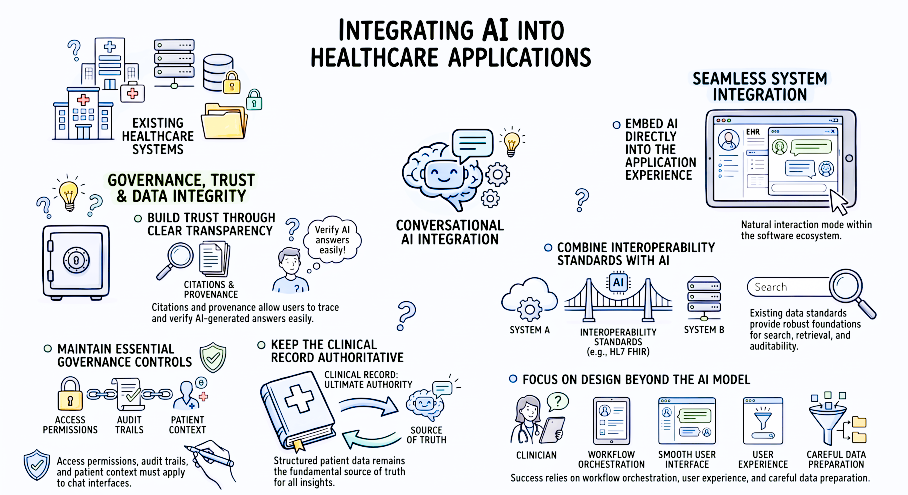
There is no shortage of discussion about AI in healthcare. New assistants appear frequently, all promising to make information easier to find, reduce administrative burden and help clinicians navigate increasingly complex records.
Recently, we came across a post that argued AI is not arriving as an autonomous overlord; it is arriving as infrastructure.
That perspective resonated with us because AI is increasingly being discussed not as a separate tool, but as something woven into the applications that health and care professionals use every day.
It prompted us to think less about the technology itself and more about the user experience around it. If AI becomes part of the applications people already use, how should it fit into those experiences? Should it sit alongside the systems users rely on today, or become another way of interacting with them?
That, ultimately, was the question that led to this series.
TL;DR
🧠 AI is becoming infrastructure, not a standalone tool
🏥 The focus is on healthcare systems, not AI models
🔍 Trust depends on transparency
🔐 Existing healthcare principles still apply
🤝 FHIR and AI work well together
The Experiment
This series grew out of a playground application we built around synthetic patient data. We integrated a conversational interface alongside a patient record, allowing people to ask questions, explore information and navigate the record in different ways.
We were not trying to prove a particular architecture, define a reference model, or establish a set of principles. We wanted somewhere safe to experiment. Somewhere to test ideas, challenge assumptions and see what practical considerations emerged when conversational AI was placed alongside a healthcare record.
The work was also a natural continuation of some of our earlier thinking around semantic layers, FHIR narratives and making healthcare data more accessible to both people and machines. We were interested in understanding how AI and healthcare interoperability standards might complement one another rather than compete with one another. Could standards such as FHIR provide useful foundations for audit, traceability and access control? Could existing healthcare patterns help make AI integrations more trustworthy? And how much of the wheel really needs reinventing?
What we found was that the most interesting questions rarely centred on the AI models themselves.
Instead, they tended to revolve around trust, accountability and user experience.
How might users know where an answer came from? What happens when an AI accesses information on behalf of a clinician? How should permissions apply to a chat interface? How much information should an AI retrieve? How should generated content be verified? At what point does an AI assistant become part of the application rather than simply sitting beside it?
One conclusion we found ourselves returning to repeatedly was that the most useful role for AI may not be to replace applications, but to integrate with and extend them.
Many AI experiences today are centred around a chat interface (or chat box, chat window). You ask a question and receive an answer. Useful though that may be, it can create a degree of separation between the user and the application itself.
Our experiments repeatedly drew us towards something slightly different.
The chat interface increasingly felt less like a destination in its own right and more like an extension of the application. Users might ask a question, but they could also follow citations, inspect source data, carry out tasks, navigate the record and verify information for themselves.
The AI was helping people interact with the record rather than replacing conventional ways of navigating it. In many situations, it felt less like a separate assistant and more like another route through the application, sitting alongside forms, lists, dashboards and search screens.
In some ways, it began to resemble the desktop AI tools many of us now use every day. The difference was that the “project” the AI was working within happened to be a patient record.
This series captures some of the observations, surprises and considerations that emerged during that exploration.
It is not intended to tell anyone how healthcare AI should be built.
It is simply a collection of things we learned while trying to understand how conversational AI, healthcare applications and interoperability standards might work together.
What Makes This Series Different?
Most writing about AI in healthcare perhaps focuses on what models can do. This series is about what happens when those models meet the realities of healthcare systems.
The question that kept emerging for us was perhaps slightly different:
If AI becomes part of healthcare systems, how might organisations retain the accountability, auditability, traceability, interoperability and trust that those systems already depend upon?
As we worked through the playground, we repeatedly found ourselves returning to questions that healthcare organisations have always had to answer. Who accessed a record? Who made a decision? Where did this information come from? Why was this recommendation made? What evidence supports it? Those questions did not disappear when AI entered the picture. If anything, they became more important.
The series also reflects our interest in how healthcare interoperability standards and AI might work together. Rather than viewing standards and AI as competing approaches, we wanted to explore whether existing standards could provide useful foundations for many of the capabilities that AI-enabled applications may need. Audit, provenance, traceability, access control and information governance are not new problems, and healthcare standards have been addressing many of them for years.
The articles that follow are not intended as recommendations. They are simply reflections on some of the practical considerations, trade-offs and unexpected discoveries we encountered whilst trying to integrate AI into a healthcare application. Hopefully they will provide useful food for thought whether you are a decision maker, clinician, architect, engineer, transformation lead or someone simply interested in the future of healthcare technology.
1. Agents Are Users Too
The first article begins with a deceptively simple idea: if an AI can read information, answer questions and perform actions on behalf of a user, perhaps it should be treated as a user of the system in its own right.
From there, it explores familiar healthcare concepts including audit trails, accountability and provenance. How might organisations record what an AI assistant has done? How might actions be attributed? How can generated outputs be traced back to the information they were derived from?
While the topic sounds technical, the underlying question is one that every organisation considering AI may eventually need to answer:
If AI starts acting on behalf of people, how do we maintain accountability?
2. A Chat Interface Is Not a Side Door
A conversational interface can feel very different from a traditional healthcare application.
Yet the data behind both experiences remains exactly the same.
This article explores what happens when existing permissions, patient context and access controls are viewed through the lens of a chat interface. If somebody is unable to access specific information through the application itself, should they be able to obtain it simply by asking a question?
More broadly, it considers how conversational experiences might be integrated into existing applications without creating a parallel set of rules and behaviours.
Anyone involved in governance, information security or digital transformation may recognise many of the challenges discussed here.
3. Citations Are Not Decoration
One of the most visible features of modern AI systems is the citation.
But what purpose does a citation actually serve?
This article examines the role of citations in helping users understand where information originates and how claims can be verified. It explores the relationship between AI-generated answers and the underlying healthcare record, and considers what happens when users need to validate what they have been told.
In doing so, it raises a broader question:
How do we ensure that AI helps people navigate information rather than simply asking them to trust it?
The result is a discussion that is as much about user confidence and transparency as it is about technology.
4. The FHIR Knowledge Base
Healthcare systems typically contain vast amounts of information.
Finding the specific information that matters to a particular question is often a different challenge entirely.
This article explores how structured healthcare records might be made easier to navigate and search whilst retaining the underlying clinical record as the source of truth. It considers how information can be represented in ways that are more accessible to both people and AI systems, and how search experiences may move beyond forms, filters and predefined reports.
For non-technical readers, it offers an introduction to how modern AI-powered search differs from traditional system search functionality. For technical readers, it explores some of the architectural considerations involved.
5. Chunking Is the New Data Modelling
This is perhaps the article with the most technical title, yet the underlying concept is surprisingly relatable.
Whenever information is organised, somebody must decide what belongs together and what should be separated.
That applies just as much to preparing information for AI as it does to designing a database or structuring a clinical record.
The article explores how those decisions influence what information can subsequently be found, understood and connected. Along the way, it reveals how seemingly small technical choices may have a significant impact on the quality of answers users ultimately receive.
Many readers may find it changes the way they think about how information is organised behind the scenes.
6. It Takes More Than One Agent
When users interact with an AI assistant, it is tempting to imagine a single piece of software sitting behind the conversation.
Reality may be more complicated.
This final article explores the idea that what appears to be one assistant may actually be a collection of specialist capabilities working together behind the scenes. It examines how responsibilities can be divided, how outputs can be validated and how organisations might think about trust when some capabilities merely retrieve information whilst others may eventually perform actions.
It also highlights a theme that runs throughout the entire series: successful AI integration is often less about the model itself and more about the processes, safeguards and human decisions that sit around it.
A Conversation Worth Having
None of the articles in this series claim to provide the right answer. They describe what we encountered, what surprised us and the considerations that emerged whilst experimenting with AI and healthcare interoperability in a safe, synthetic environment.
We hope they help stimulate discussion within your own organisation. If nothing else, perhaps they will encourage conversations between clinicians, transformation teams, architects, engineers and technology leaders about how AI should fit into the applications and services they already provide.
Because ultimately, AI is unlikely to succeed in healthcare by existing separately from our systems. Its greatest value may come when it becomes a well-integrated, trustworthy and accountable part of them.
And if these articles spark ideas, questions or healthy disagreement, we’d be delighted to continue the conversation.
Whether you are developing an AI strategy, modernising healthcare applications, exploring interoperability platforms or looking at ways to introduce AI into clinical and operational systems, come and talk to us. We’d love to hear about the challenges you’re trying to solve and share some of the lessons we learned along the way.
