
Reflections on the Social Care Interoperability Platform Hack Day
The Social Care Interoperability Platform (SCIP) Hack Day brought together six NHS assured digital social care record (DSCR) system providers to test the practical realities of interoperability using a prototype federated integration platform deployed specifically to support the event. Working from a shared data model (MODS) and transforming to and from FHIR, teams were able to publish, retrieve, and consume synthetic data end-to-end within a single day.
What emerged was both encouraging and instructive: interoperability is technically achievable when working from a common foundation, but scaling it raises deeper challenges around data quality, governance, and consistency. While rich clinical data sharing remains complex, even simple, timely notifications about where a person is and who to contact could deliver immediate value across health and social care.
TL;DR
🔧 Six NHS assured DSCR providers integrated with a prototype interoperability platform in a hands-on hack day
🧩 MODS provided a shared foundation for social care data, enabling consistent exchange
🔄 Bi-directional transformation between MODS and FHIR allowed systems to both publish and consume data
✅ Teams successfully completed end-to-end flows and some went beyond the original scope
⚠️ Common challenges emerged, especially around de-duplication and data ownership
🧠 Flexible integration patterns were demonstrated, including mixing MODS writes with direct FHIR reads
🚑 There is strong appetite to expand into wider health data, particularly notifications from secondary care
🏛️ Governance, rather than technology, remains the primary barrier to scaling interoperability
📞 Even simple administrative data sharing could significantly improve current processes
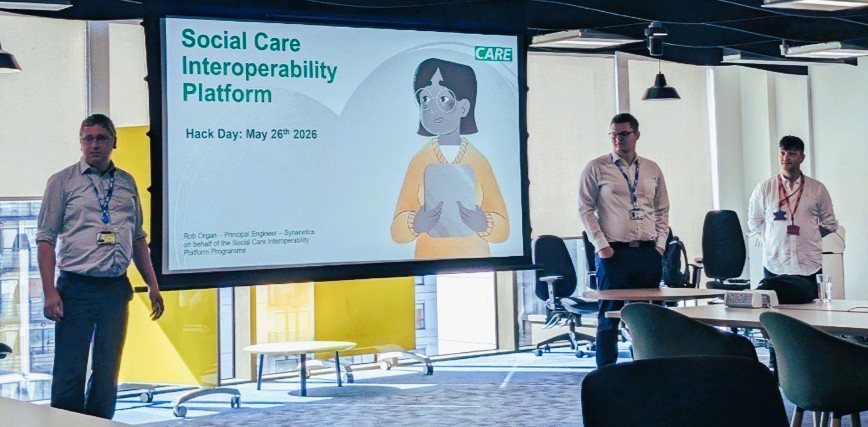
The SCIP Hack Day brought together six NHS assured digital social care record (DSCR) system providers, supported by a multidisciplinary SCIP team combining technical expertise with broader delivery and operational perspectives, to explore the practical feasibility of integrating with a prototype federated integration platform. The platform was deployed specifically to support the hack day activities.
Designed as a hands-on engineering workshop rather than a demonstration, the event focused on validating real end-to-end data flows. In particular, it explored how data could be created within DSCR systems and exchanged across the platform using synthetic data.
A key enabler for this was the use of Minimum Operational Data Standard (MODS). Unlike healthcare, and secondary care in particular, where long-established integration standards such as HL7v2 have often resulted in specialised message formats layered over time, social care presents a more open, greenfield landscape. MODS is emerging as a shared data model that assured providers are working towards, establishing a common foundation for representing person-centred information and enabling interoperability from a consistent starting point.
This provided a much-needed foundation for the hack day. Rather than each provider interpreting and structuring data differently, MODS established a consistent baseline from which data could be exchanged and understood - it’s a common format that each system provider can produce. Crucially, it enabled bi-directional transformation between MODS and FHIR, which is the standard used by the integration platform. This allowed data to be both published into the platform and re-consumed in a consistent, system-aligned format. In turn, this supported a clean and scalable approach to integration in a sector that previously had no shared “language” for data exchange.
The aim was not only to prove that these flows work in practice, but also to generate tangible evidence of onboarding readiness, identify technical gaps, and capture actionable learnings with the potential to inform next steps. From an organiser perspective, our role was to coordinate the event and provide hands-on support, moving between teams to help unblock issues. This proved particularly effective in a face-to-face setting compared to virtual delivery.
What Happened
In essence, each participant integrated their software with a data provision layer that forms part of the wider platform architecture. This layer acted as a tenant-specific component responsible for transforming data between MODS and FHIR. It ensured that data presented to the platform aligned with the FHIR standards it expects, while still allowing systems to operate using their native data models.
The MODS Adapter played a key role in this. It acted as the transformation engine and exposed a FHIR $transform operation, which allowed teams to convert data retrieved from the platform back into MODS structures where needed. This approach provided both agility and flexibility in how systems integrated, while maintaining a consistent, standards-aligned interface to the platform.
Teams then worked through a set of pre-defined integration tasks designed to validate end-to-end data flows across the platform. This included registering a Subject of Care, publishing an “About Me” record in MODS, and retrieving that data via the interoperability platform using FHIR R4.
In practice, participants first established a linkage between their systems and the central platform so that it could recognise where data about an individual exists. They then created and sent person-centred “About Me” records via their own tenanted components, demonstrating how data can be structured, transformed, and stored. Finally, teams retrieved that information from the platform and displayed it within their own systems, validating real consumption and reuse of shared data.
Participants successfully completed these tasks and demonstrated working integrations within their own test environments. A few teams went beyond the brief, extending their work to ingest and use additional test data.
What Worked Well
A key success was the level of active engagement, with participants successfully exchanging data between systems and a central platform. This demonstrated that interoperability is achievable in practice. A few teams progressed beyond basic integration, displaying shared data within their own software and illustrating how this could translate into real-world scenarios.
Discussions quickly moved beyond the initial tasks. Participants explored more complex challenges such as managing data from multiple sources for a single individual. They also worked with additional MODS data structures and FHIR resources beyond those defined in the initial tasks, and showed strong enthusiasm to take the work further.
Challenges and Learnings
Participants highlighted data complexity as a significant challenge, particularly around handling duplicate records and determining how to merge or prioritise information without losing important historical context. More broadly, de-duplication is a well-established challenge across health and care, particularly in shared care records, where there is often no single authoritative approach.
In practice, this means decisions perhaps sit with consuming applications, which makes consistency harder to achieve. That said, it was encouraging to see the hack day prompt active discussion on this topic, with participants beginning to explore how these challenges might be addressed in practice.
An interesting pattern also emerged in how participants chose to interact with the platform. While many used the MODS Adapter for publishing, some opted to consume FHIR data directly when retrieving information. This reinforced the flexibility of the approach. It showed that while a common data model provides a strong foundation, there is still room for variation in how systems integrate depending on their capabilities and design choices.
There was also feedback that clearer upfront context would have been beneficial. The technical “how-to” was perhaps introduced before a shared understanding of the broader purpose. This is something I will take forward, balancing my natural tendency to focus on delivery with ensuring clarity of intent from the outset.
Looking Ahead
There is clear appetite to build on this progress, particularly by expanding the scope to include primary and secondary care data. Participants highlighted the value of features such as automatic notifications when individuals are admitted to or discharged from hospital, reinforcing the practical benefits that interoperability could unlock.
Whether such notifications include clinical data is clearly part of a broader governance consideration. However, even the sharing of administrative information, enabling carers to understand where a person is, when key events occur, such as an unplanned or urgent hospital admission, and who to contact, would represent a meaningful improvement on the current status quo. At present, across both social care and the wider healthcare system, this often relies on manual processes such as phone calls and time spent trying to locate individuals or identify the right point of contact.
There was also a strong sense that attendees are seeking true two-way data flows. This builds on the bi-directional exchange demonstrated during the day and aligns with the longer-term ambition of enabling a more connected, system-wide view of care.
Closing Reflection
Overall, the day demonstrated both the feasibility of the approach and the value of bringing providers together in a collaborative, hands-on environment to accelerate progress. It also highlighted that the technical barriers to integration are relatively low when organisations work together towards a shared goal.
However, the more significant challenge, and perhaps the primary barrier to wider adoption, sits beyond the technology in governance. While the hack day showed that systems can exchange and consume data, scaling this across the wider health and care system raises fundamental questions around access. This includes who can view clinical information, under what circumstances, and how those decisions are applied consistently across roles and organisations.
Addressing this in a way that is safe, trusted, and scalable will be critical to realising the full potential of system-wide interoperability.
And finally…
A huge thank you to everyone who contributed to making the event such a success. The level of engagement, collaboration, and willingness to explore new approaches was clear throughout the day.
In particular:
- Colleagues from Synanetics
- Colleagues from the NHS England/Department of Health and Social Care Joining Up Data/SCIP Programme
- NHS England for providing the venue!
And to the following organisations for supporting the event by releasing engineering time and enabling meaningful participation:
It genuinely would not have been possible without your support. Thank you for helping make it happen 🙏.
